Research
Dissertation / Book Project
The Politics of Environmental Risk: Knowledge, Rights, and Climate Action in Rio de Janeiro
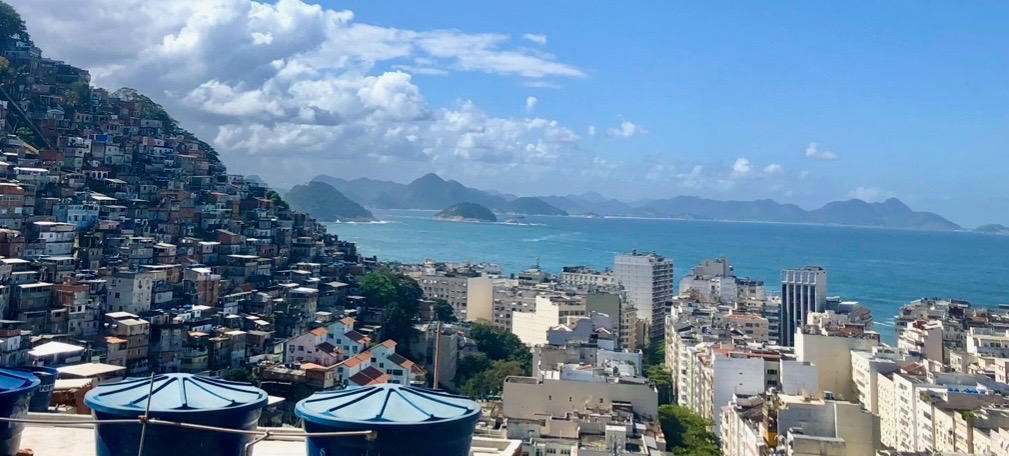
My ongoing dissertation and book project explores how local climate adaptation interventions in Rio de Janeiro’s favelas (informal settlements) are brokered between the state and residents of at-risk communities. Roughly one billion people live in informal settlements globally, and they are among the populations most vulnerable to climate change. Yet state responses to the risks they face vary widely: some communities receive infrastructure projects that reduces risk while keeping them in place, others are relocated from their homes in at-risk areas, and many more face prolonged inaction. My dissertation asks why residents of informal settlements facing comparable environmental risk receive such different responses from the state. I theorize state responses to climate hazards such as floods and landslides as a fundamentally distributive politics. Scholars have long studied how governments allocate goods like roads, water, and housing among the urban poor. However, the allocation of protection from environmental harm has scarcely been examined in these terms, even as the mounting costs of climate hazards in cities have made it an increasingly vital form of state action. I provide an account of how these uneven responses to environmental risk are negotiated among city governments, residents, housing and environmental movements, and what I call “expert intermediaries,” such as engineers, urban planners, lawyers, and journalists, who produce and translate information about risk between residents and the state.
The project draws upon five sets of original data, combining quantitative and qualitative evidence. I conducted twelve months of fieldwork in Rio de Janeiro, including interviews with municipal officials, residents, and non-state actors, alongside participant observation of public hearings, technical site visits, planning meetings, and other spaces where interventions in at-risk areas are deliberated. I also construct an original panel dataset of geolocated municipal environmental interventions across more than 1,000 favelas over sixteen years, assembled through freedom of information requests. Additionally, I fielded an original household-level survey (n = 800) of a flood-prone community in Rio’s northern periphery, developed with local community partners and paired with street-level flood risk data. Finally, I draw upon detailed documentation of thirty court cases in which resettlements justified by environmental risk become contested through legal channels.
Book Chapters
Just Economic Transition and Cities: Impacts and Challenges of Including Subnational Governments. In Luedemann, Gustavo Alves and Cristina Fróes de Borja Reis (eds.), A Just Transition in Brazilian Finance. Brasília: Brazilian Institute for Applied Economic Research (IPEA), Ministério da Fazenda, GIZ, 2026. With Vanessa Nadalin, Jean Peres, and Raphael Brito Faustino (In Portuguese, forthcoming in English). [Chapter]
Working Papers & Under Review
Repertoires of Knowledge Mobilization: How the Urban Poor Reshape Climate Risk (Under Review) [Working Paper]
On the margins of the world’s cities, residents of informal settlements often experience the most direct effects of climate change yet remain largely excluded from adaptation planning, instead becoming subjects of bureaucratic designations that contradict their lived experiences and local knowledge. This article examines how the urban poor mobilize to exert political agency over the knowledge which shapes local climate action. Drawing on twelve months of fieldwork in Rio de Janeiro’s favelas, I combine interviews with participant observation across climate-vulnerable communities and sites of citizen-state deliberation. I argue that information about climate risk is not merely a precondition of political mobilization or a neutral input into state decision-making, but a contested domain of citizen action in its own right. I conceptualize this engagement as knowledge mobilization: the patterned, collective practices through which residents deploy information about the problems they face to shape the nature of state action in their communities. I develop a typology of three strategies by which residents of at-risk communities extract information from the state, enlist outside expertise, and produce their own evidence about the conditions they face. In doing so, the urban poor seek to redefine their role in local climate governance, asserting themselves as protagonists in shaping local climate action from below.
Is Patriotism Inclusive? National Identity and Environmentalism in Bolivia, with Christopher Carter (Under Review) [Working Paper]
Does patriotism cross-cut societal cleavages? Scholars often argue that patriotism—in contrast to the related concept of nationalism—invokes positive sentiments toward one’s country without asserting superiority to others. If so, patriotism may foster an inclusive national identity, bridging societal divisions and promoting concerted action on policy issues for which costs are concentrated among a narrowly defined set of residents. In this paper, we use environmental crises in Bolivia as a case to test whether patriotism may transcend regional cleavages on such issues. In a survey experiment with novel measures of patriotism and environmentalism in the department of Cochabamba, we find patriotism is less inclusive than traditionally thought. While patriotism increases environmental concern through mechanisms of shared solidarity and ties to national symbols, patriotic individuals show this heightened concern only when environmental crises are present in their home region. Instead of being an inclusive identity, patriotism may instead reinforce existing regional cleavages.
Secondhand Skepticism: Trust, Polarization, and the Partisan Activation of Science Opinion, with Paul Freedman (Under Review) [Working Paper]
In an era of intense partisan polarization, debates over some scientific issues have become sharply divided along party lines, while others have remained relatively free of partisan conflict. In this paper, we ask whether and how partisan divisions on one scientific issue can spill over across domains, reshaping opinion even on issues not previously divided by party. In the context of the highly partisan debate surrounding COVID-19 vaccination policies, we argue that even brief engagement with this polarized debate can activate partisan-motivated reasoning which frames how individuals form judgments about other, non-politicized scientific domains. We test this argument using an original survey experiment in the 2022 Cooperative Election Study (CES). Leveraging the sharp asymmetry between deeply polarized opinion on COVID-19 vaccination and the largely non-partisan debate over genetically modified organisms (GMOs), we employ a simple experiment randomizing the order in which respondents answer a battery of questions about each issue. We show that priming respondents with questions on COVID-19 vaccination significantly reshapes GMO opinion along party lines, producing partisan divisions that are otherwise absent. Our findings suggest that partisan distrust in one scientific domain has the potential to spill over to unrelated scientific issues, reflecting how the politicization of science can undermine public trust more broadly.
On Uneven Ground: The Distributive Politics of Climate Adaptation in Rio de Janeiro [Working Paper]
Why do states pursue different interventions in informal settlements facing comparable levels of environmental risk? As cities are increasingly on the front lines of climate change, local governments face mounting pressure to reduce the risk posed by hazards such as floods and landslides, which fall heaviest on the urban poor. Yet state responses to these threats vary widely, ranging from infrastructural upgrading projects to relocation of residents to prolonged inaction. In this paper, I argue that where risk is widespread but the state’s knowledge of that risk is uneven, governments retain substantial discretion over where and how to intervene, enabling action targeted along political and economic lines rather than environmental ones. Drawing on an original dataset of geolocated municipal interventions and twelve months of fieldwork in Rio de Janeiro, I show that state responses across informal settlements are shaped not by the severity of risk alone, but also by settlements’ electoral alignment and surrounding real estate pressures. In doing so, I provide an account of the distributive politics of urban climate adaptation, in which the state’s classification of “risk areas” becomes a vehicle for broader political and economic interests in informal settlements, pursued under the ostensibly technical, depoliticized language of environmental risk. As climate hazards intensify, the question of whom the state protects from environmental harm and whom it leaves exposed has become a central axis of urban inequality and a key domain through which cities reorder territory, citizenship, and the right to the city.
Work in Progress
Citizen-State Encounters and Patterns of Participation in Urban Peripheries: Evidence from Rio de Janeiro, with Winston Ardoin (Data collection in progress)
How do negative interactions with the state shape patterns of political participation in marginalized communities? We argue that divergent forms of state action—predation through exposure to routinized and predatory policing and neglect via the absence of public goods provision—channel citizen mobilization in distinct directions: predation pushes citizens away from the state toward non-state actors and institutions, while neglect motivates claim-making directed at the state. We field a survey experiment of residents of Rio de Janeiro’s favelas (informal urban settlements), where predation and neglect coexist with an uneven terrain of social welfare provision. We field an original survey recruited through geographically micro-targeted ads on social media platforms to capture variation across settlements. In interactive vignette experiments, we vary narratives of state action across different domains of local governance—trash collection, policing, and housing—and measure their effects on two indices of political engagement: respondents’ willingness to engage in a range of political activities and which actors they see as more or less likely to be able to help solve community-level challenges. We disaggregate these activities and actors to test the directionality of engagement in what we term non-state and state-directed political participation. Preliminary results from a pilot study (n = 280) highlight that debates regarding the determinants of political participation lack a crucial dimension of directionality: distinct patterns of citizen-state encounters produce variegated forms and targets of citizen mobilization and claim-making.
A Flood of Information: Local Environmental Action in Unequal Cities, with Gabrielle Kruks-Wisner and Bhumi Purohit (Data collection in progress)
In cities around the world, residents experience climate hazards such as flooding, landslides, and extreme heat, which are deeply unequal in incidence and impact. Low citizen mobilization is often attributed to missing information or low salience. We argue instead that (in)action cannot be explained by resident knowledge of risks, which are already well known and highly salient. Rather, what matters is how people interpret that information, and how risk is framed: how causes and responsibility are attributed, and whether solutions appear actionable. We therefore ask: when can information mobilize—and when can it demobilize—citizen action and claim-making on environmental issues? We take this up in Mumbai and Rio de Janeiro, coastal cities in middle-income
democracies marked by profound inequality in citizen–state engagement, where floods are unequally experienced. Drawing on focus groups and interviews in both cities, we field surveys with an embedded experiment presenting a citizen-reported social media post. We randomize the cause it identifies (infrastructural deficiencies, land use policy, climate change) and whether flooding’s unequal burden is made explicit. We measure attention, blame and responsibility attribution, emotion, and stated and observed willingness to act, testing whether responses differ by housing formality and prior flood exposure. In doing so, we specify when digital information about environmental risk catalyzes citizen mobilization, and when it reinforces despondency and disengagement from local governance
The Politics of Protection: Who Gets Climate Infrastructure in Brazil’s Cities, with Flávia Leite (Data collection in progress)
Social Class, Resource Origin, and Fairness: Lab-in-the-Field Evidence from Cochabamba, Bolivia, with
Christopher Carter, Kirill Zhirkov, and Pablo Velasco Oña (Data collection in progress)